
World population hits 8 billion, Women live longer than men, India population to surpass China in 2023
World population continues to grow, but the pace of growth is slowing down- United Nations
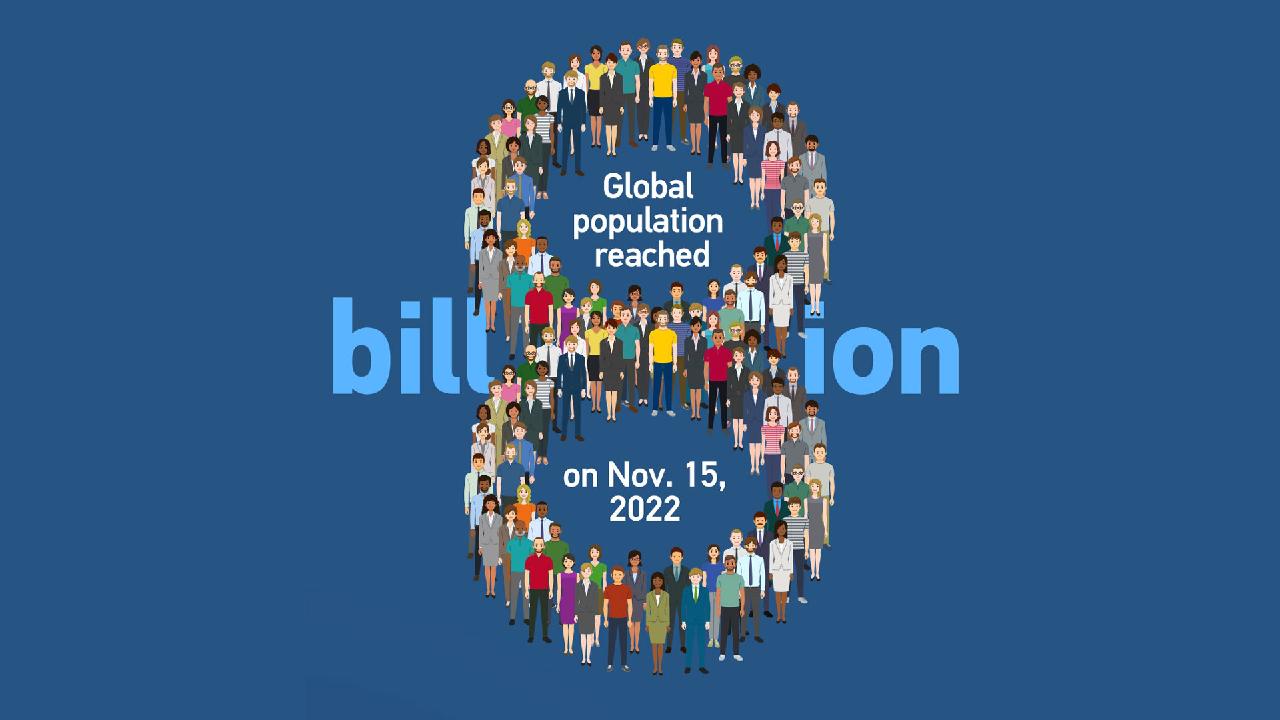
World population is projected to reach 8 billion by 15 November 2022. Looking ahead, the UN Population Division’s forecast predicts that the world’s population will already exceed ten billion by 2059
The latest projections by the United Nations suggest that the global population could grow to around 8.5 billion in 2030, 9.7 billion in 2050 and 10.4 billion in 2100.
Population growth is caused in part by declining levels of mortality, as reflected in increased levels of life expectancy at birth. Globally, life expectancy reached 72.8 years in 2019, an increase of almost 9 years since 1990. Further reductions in mortality are projected to result in an average longevity of around 77.2 years globally in 2050.
Life expectancy at birth for women in 2019 exceeded that for men by 5.4 years globally, with female and male life expectancies standing at 73.8 and 68.4, respectively. A female survival advantage is observed in all regions and countries, ranging from 7 years in Latin America and the Caribbean to 2.9 years in Australia and New Zealand.
Following a drop in mortality, population growth continues so long as fertility remains at high levels. When fertility begins to fall, the annual rate of growth starts to drop.
In 2021, the average fertility of the world’s population stood at 2.3 births2 per woman over a lifetime, having fallen from about 5 births per woman in 1950. Global fertility is projected to decline further to 2.1 births per woman by 2050.
In 2020, the global population growth rate fell under 1 per cent per year for the first time since 1950. The world’s population is projected to reach a peak of around 10.4 billion people during the 2080s and to remain at that level until 2100.
Two-thirds of the projected increase in global population through 2050 will be driven by the momentum of past growth that is embedded in the youthful age structure of the current population. Such growth would occur even if childbearing in today’s high-fertility countries were to fall immediately to around two births per woman.
Given that most population increase until 2050 will be driven by the momentum of past growth, further actions by Governments aimed at reducing fertility would do little to slow the pace of growth between now and mid-century, beyond the gradual slowdown indicated by the projections presented here. Nevertheless, the cumulative impact of such changes could contribute to a more substantial reduction of global population growth in the second half of the century.
Sustained high fertility and rapid population growth present challenges to the achievement of sustainable development. The necessity of educating growing numbers of children and young people, for example, draws resources away from efforts to improve the quality of education.
For countries with continuing high levels of fertility, achieving the Sustainable Development Goals (SDGs), particularly those related to health, education and gender, is likely to hasten the transition towards lower fertility and slower population growth.
According to the www.statista.com the world population is growing by around 82.4 million people a year. The countries with the highest population growth in 2021 were Syria, Niger and Equatorial Guinea. Overall, the ranking is dominated by African countries. By contrast, the list of countries with the highest population decline is dominated by eastern and southeastern European states, which have to contend with high emigration figures due to the wage and development gap with western Europe.
Rates of population growth vary significantly across countries and regions
In 2022, the two most populous regions were both in Asia: Eastern and South-Eastern Asia with 2.3 billion people (29 per cent of the global population), and Central and Southern Asia with 2.1 billion (26 per cent). China and India, with more than 1.4 billion each, accounted for most of the population in these two regions.
More than half of the projected increase in global population up to 2050 will be concentrated in just eight countries: the Democratic Republic of the Congo, Egypt, Ethiopia, India, Nigeria, Pakistan, the Philippines and the United Republic of Tanzania. Disparate growth rates among the world’s largest countries will re-order their ranking by size.
India is projected to surpass China as the world’s most populous country during 2023.
Countries of sub-Saharan Africa are expected to continue growing through 2100 and to contribute more than half of the global population increase anticipated through 2050.
Whereas the populations of Australia and New Zealand, Northern Africa and Western Asia, and Oceania (excluding Australia and New Zealand) are expected to experience slower, but still positive, growth through the end of the century, the populations of Eastern and South-Eastern Asia, Central and Southern Asia, Latin America and the Caribbean, and Europe and Northern America are projected to reach their peak size and to begin to decline before 2100.
The 46 least developed countries (LDCs) are among the world’s fastest-growing. Many are projected to double in population between 2022 and 2050, putting additional pressure on resources and posing challenges to the achievement of the Sustainable Development Goals (SDGs).
For many countries and areas, including some small island developing States (SIDS), the challenges posed by rapid growth are compounded by their vulnerability to climate change and sea-level rise.
Levels and patterns of fertility and mortality vary widely around the world
The gap in life expectancy at birth between certain groups of countries remains wide. In 2021, life expectancy in the least developed countries lagged 7.0 years behind the global average, due largely to persistently high levels of child and maternal mortality and, in some countries, to violence and conflict or to the continuing impact of the human immunodeficiency virus (HIV) epidemic.
In 2021, fertility levels high enough to sustain positive population growth were found in sub-Saharan Africa (4.6 births per woman), Oceania excluding Australia and New Zealand (3.1), Northern Africa and Western Asia (2.8), and Central and Southern Asia (2.3).
Some countries, including several in sub-Saharan Africa and in Latin America and the Caribbean, continue to experience high levels of adolescent fertility, with potential adverse consequences for the health and well-being of both the young mothers and their children.
In 2021, 13.3 million babies, or about 10 per cent of the total worldwide, were born to mothers under 20 years old.
The population of older persons is increasing both in numbers and as a share of the total
The share of the global population aged 65 years or above is projected to rise from 10 per cent in 2022 to 16 per cent in 2050.
By 2050, the number of persons aged 65 years or over worldwide is projected to be more than twice the number of children under age 5 and about the same as the number of children under age 12.
Whereas population growth at older ages is driven by lower mortality and increased survival, an upward shift in the population age distribution is caused by a sustained drop in the fertility level.
Because of the female advantage in life expectancy, women outnumber men at older ages in almost all populations.
Globally, women comprised 55.7 per cent of persons aged 65 or older in 2022, and their share is projected to decline slightly to 54.5 per cent by 2050.
Countries with ageing populations should take steps to adapt public programmes to the growing proportion of older persons, including by improving the sustainability of social security and pension systems and by establishing universal health care and long-term care systems.
By 2050, 70 percent of the world’s population will live in cities, up from 54 percent in 2020, according to a new report by the Institute for Economics & Peace. This increase is being driven by both population growth and a continued shift towards urbanization, particularly to so called ‘megacities’ – metropolises that have a population of 10 million or more.
By 2050, 70 percent of the world’s population will live in cities, up from 54 percent in 2020, according to a new report by the Institute for Economics & Peace. This increase is being driven by both population growth and a continued shift towards urbanization, particularly to so called ‘megacities’ – metropolises that have a population of 10 million or more.
Urbanization takes place because of both push and pull factors. The IEA describes how in the Democratic Republic of Congo’s capital of Kinshasa, factors pushing people away from rural areas include issues of violence and a general lack of security, the presence of criminal groups, lack of policing, ecological degradation, and the fact there are too many people for the available agricultural land. Meanwhile, a pull factor could be the attraction of an increase in the standard of living.
According to an article at www.statista.com, there are currently 33 megacities worldwide. Tokyo (37.3 million), Delhi (32.3 million), Shanghai (28.7 million), Dhaka (22.6 million), São Paulo (22.5 million) and Mexico City (22.1 million) take the lead as the most populous of these.
By 2050, 14 more cities are set to join their ranks, with a total increased population of some 213 million people. The new order will then become Delhi (49.6 million), Dhaka (34.6 million), Tokyo (32.6 million), Cairo (32.6 million) and Mumbai (32.4 million). In addition to a rise in the number of people living in these cities, the countries themselves will also likely see economic growth.
According to AXA, Manila in the Philippines and Bangalore in India are expected to see close to 150 percent GDP growth by the end of the decade. Africa is the only world region expected to still see strong population growth by the end of the century, according to the Pew Research Center, while all other regions’ growth rates will start to tail off.